

In the world of motion control, servo motors are often selected for their precision, efficiency, and ability to dynamically respond to complex motion profiles. Two essential concepts that engineers must understand when working with servo systems are RMS torque and intermittent torque. These values play a critical role in selecting the right motor for an application—especially when that application involves variable loads, cycles, or accelerations.
Let’s explore what RMS and intermittent torque mean, how they affect performance, and how servo motors compare to their stepper counterparts.
What Is RMS Torque?
RMS (Root Mean Square) torque represents the continuous torque that a servo motor can deliver without overheating over an extended period. Think of it as the motor’s “average workhorse strength.” It is calculated from the torque values experienced throughout a motion cycle, incorporating both high and low torque demands.
This is important because motors heat up due to current flow, and excessive heat degrades winding insulation, reduces lifespan, or triggers thermal shutdown. The RMS torque accounts for thermal limitations and ensures that the motor remains in a safe operating range.
In practical terms:
-
If your motion profile involves low-load cruising interspersed with bursts of high torque (e.g., accelerating a load), the RMS torque smooths those peaks into a single number representing the sustained thermal load.
What Is Intermittent Torque?
Intermittent torque (sometimes called peak torque) is the maximum torque a servo motor can produce for a short duration—typically a few seconds—without risking damage.
This value is especially important in applications involving rapid acceleration, deceleration, or overcoming high static loads (like breaking free from inertia). However, it cannot be sustained for long due to thermal limits and magnetic saturation.
A few things to note:
-
If a system repeatedly demands peak torque, a larger motor or cooling method might be necessary.
-
Most servo drives limit how long peak torque can be applied to protect the motor.
Torque vs. Speed: Performance Profile
Servo motors offer a relatively flat torque curve across a wide speed range. This is a major reason they are preferred for dynamic applications. At low speeds, full rated torque is available, and it remains stable until reaching the motor’s base speed. Beyond this, torque typically begins to decline due to back EMF and current limitations.
This relationship forms a characteristic torque-speed curve:
-
Constant torque region: From 0 to base speed.
-
Constant power region: From base speed to maximum speed, where torque decreases as speed increases.
This contrasts significantly with stepper motors, which deliver maximum torque at low speeds, but lose torque rapidly as speed increases due to current drop-off and rotor inertia. Servo motors, therefore, provide better performance at higher speeds, making them ideal for fast, high-torque motion profiles.
Stepper Motors vs. Servo Motors: Torque Characteristics
| Feature | Servo Motor | Stepper Motor |
|---|---|---|
| Torque at Low Speed | High and consistent | Very high |
| Torque at High Speed | Stable, better than steppers | Drops off quickly |
| RMS Torque Consideration | Crucial for thermal design | Not applicable in same way |
| Intermittent (Peak) Torque | Available, limited duration | No peak torque—torque limit is fixed |
| Feedback | Requires encoder/resolver | Typically open-loop (unless closed-loop stepper) |
| Efficiency | Higher, due to closed-loop control | Lower, due to constant current draw |
| Motion Control | Smooth, precise, dynamic | Coarser motion without feedback |
Stepper motors are simpler and cheaper but are not thermally optimized for RMS/peak torque trade-offs. Their torque is more or less constant at stall and cannot spike momentarily like in a servo system.
Why RMS and Intermittent Torque Matter in Real Applications
Consider a pick-and-place machine or CNC mill:
-
Rapid accelerations demand peak torque to move the load quickly.
-
Sustained operations, like cutting or positioning, require reliable continuous torque.
If the servo is undersized based on intermittent torque alone, it may overheat during long duty cycles. If only RMS torque is considered, it may lack the power to accelerate or handle shocks. A proper balance ensures both thermal safety and mechanical performance.
Final Thoughts
When designing with servo motors, don’t just look at the torque rating on the datasheet—understand whether it’s RMS or peak, and match it to your application’s motion profile. Consider thermal load, duty cycle, and speed requirements carefully.
In contrast to stepper motors, servo motors provide more flexibility, power density, and control. Their ability to manage torque over speed and respond dynamically to changes is what makes them the preferred choice for demanding automation and robotics systems.
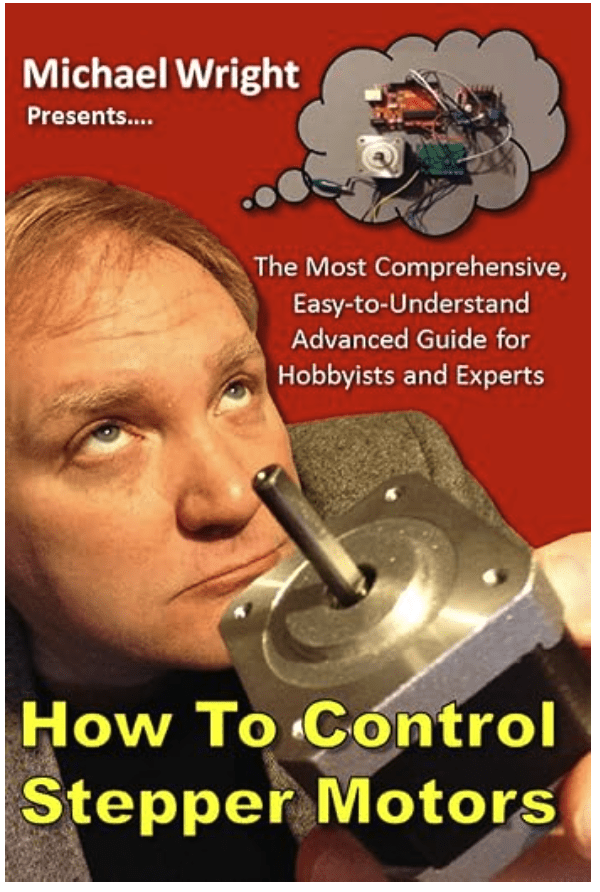 Finally—a practical, beginner-friendly guide to stepper motor control!
You don’t need to be an electrical engineer or rocket scientist to master stepper motors. Whether you’re a curious elementary student, a high school hobbyist, or a seasoned robotics engineer, this book by Michael Wright makes the complex simple.
With clear explanations and hands-on examples, you’ll learn exactly how to identify, wire, and program stepper motors for your robotic projects. No guesswork. No jargon. Just real-world guidance.
Inside, you’ll discover:
-
Full and half stepping for both unipolar and bipolar motors
-
Microstepping explained from scratch—finally demystified!
-
How to identify various types of stepper motors
-
Simple methods to determine wire functions and pinouts
-
How to use popular motor controllers:
ULN2003A, X113647, L293D, L298N, TB6600, FQP30N06L MOSFET -
Easy-to-follow wiring diagrams and circuit guidance
-
Arduino microcontroller programming basics
-
Line-by-line code walkthroughs so you truly understand what’s happening
Whether you’re building your first robot or refining your motion control setup, this is the go-to guide you’ve been waiting for. More information…
