

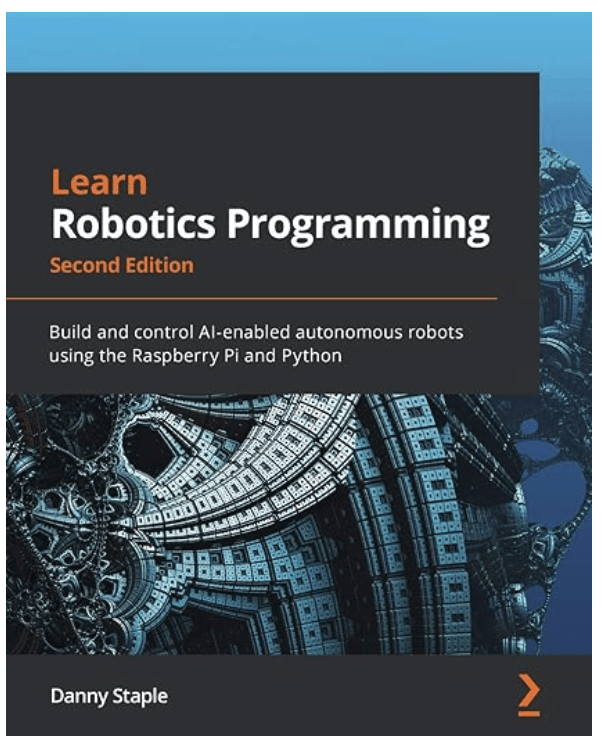
 Learn how to build intelligent, voice-controlled robots using Python and Raspberry Pi. Discover hands-on robotics programming, sensor integration, AI features, and modular design in this comprehensive robotics guide.
Key Features
-
Master the fundamentals of robotics programming with practical, hands-on examples using Raspberry Pi and Python
-
Build a fully functional robot from scratch and customize it with modular components
-
Learn to integrate a voice-based AI agent that can control your robot through spoken commands
-
Enable your robot to detect, react to, and navigate around obstacles using a wide array of sensors
-
Integrate camera vision and image processing to add sight and intelligence to your robot
-
Connect your robot to the internet and control it remotely via smartphone, tablet, or web interface
-
Design your robot with future enhancements in mind—expand its capabilities with minimal redesign
-
Apply principles of machine learning and artificial intelligence to create dynamic and adaptive behaviors
Book Description
In today’s world, robots are no longer a concept of the distant future—they are transforming industries, education, and everyday life. From automating repetitive tasks to serving as personal assistants, smart robots have the potential to enhance productivity and simplify life in profound ways.
Learn Robotics Programming, Second Edition offers an immersive, project-based approach to learning how to build intelligent robots that can sense, think, act, and evolve. Using the affordable and versatile Raspberry Pi platform, combined with the power of Python, this book guides you through every step of designing and developing a feature-rich, extendable smart robot.
You’ll begin by understanding the basic anatomy of a robot—its frame, brain, sensors, and actuators. Then, you’ll dive into hardware setup, wiring, and electronics, followed by writing Python code to control motors, read sensor data, and implement logic-based decisions. As you progress, you’ll integrate AI features like voice recognition, speech synthesis, and visual processing using a camera module and machine vision libraries.
Each chapter builds on the last, introducing increasingly advanced concepts including autonomous navigation, remote communication, cloud integration, and machine learning. With a focus on modular design, you’ll learn to structure your robot in a way that allows easy upgrades and customizations—whether you want to add new sensors, extend control systems, or enhance intelligence.
By the end of this book, you’ll have built a robust robot capable of performing complex tasks, reacting to its environment, and even communicating intelligently—all while gaining the tools and confidence to build future robotic projects of your own.
What You Will Learn
-
Understand the hardware and software components that make up a smart robot
-
Install and configure Raspberry Pi OS with the necessary robotics libraries and drivers
-
Control servo and DC motors for movement, rotation, and navigation
-
Interface with ultrasonic, IR, light, and touch sensors to collect and interpret environmental data
-
Write Python code to implement decision-making algorithms and autonomous behaviors
-
Use open-source tools like OpenCV to enable your robot to “see” and respond to visual input
-
Add a microphone and speaker to build an interactive voice assistant using speech recognition APIs
-
Set up web-based or mobile remote control using Flask, MQTT, or other networking tools
-
Apply AI and machine learning basics to give your robot adaptive or predictive capabilities
-
Learn best practices for prototyping, troubleshooting, and iterating your robotic designs
Who This Book Is For
This book is ideal for programmers, hobbyists, educators, STEM students, and makers who are eager to build real-world robots that go beyond basic movement. Whether you’re exploring robotics for the first time or looking to take your projects to the next level, this guide provides the tools, theory, and inspiration to bring your robotic visions to life.
A working knowledge of Python will help you move faster, but even readers with minimal programming experience will find the step-by-step approach easy to follow. Engineers looking to explore rapid prototyping, educators running robotics courses, or anyone curious about the intersection of AI and physical computing will find this book a valuable and exciting resource. More information…
